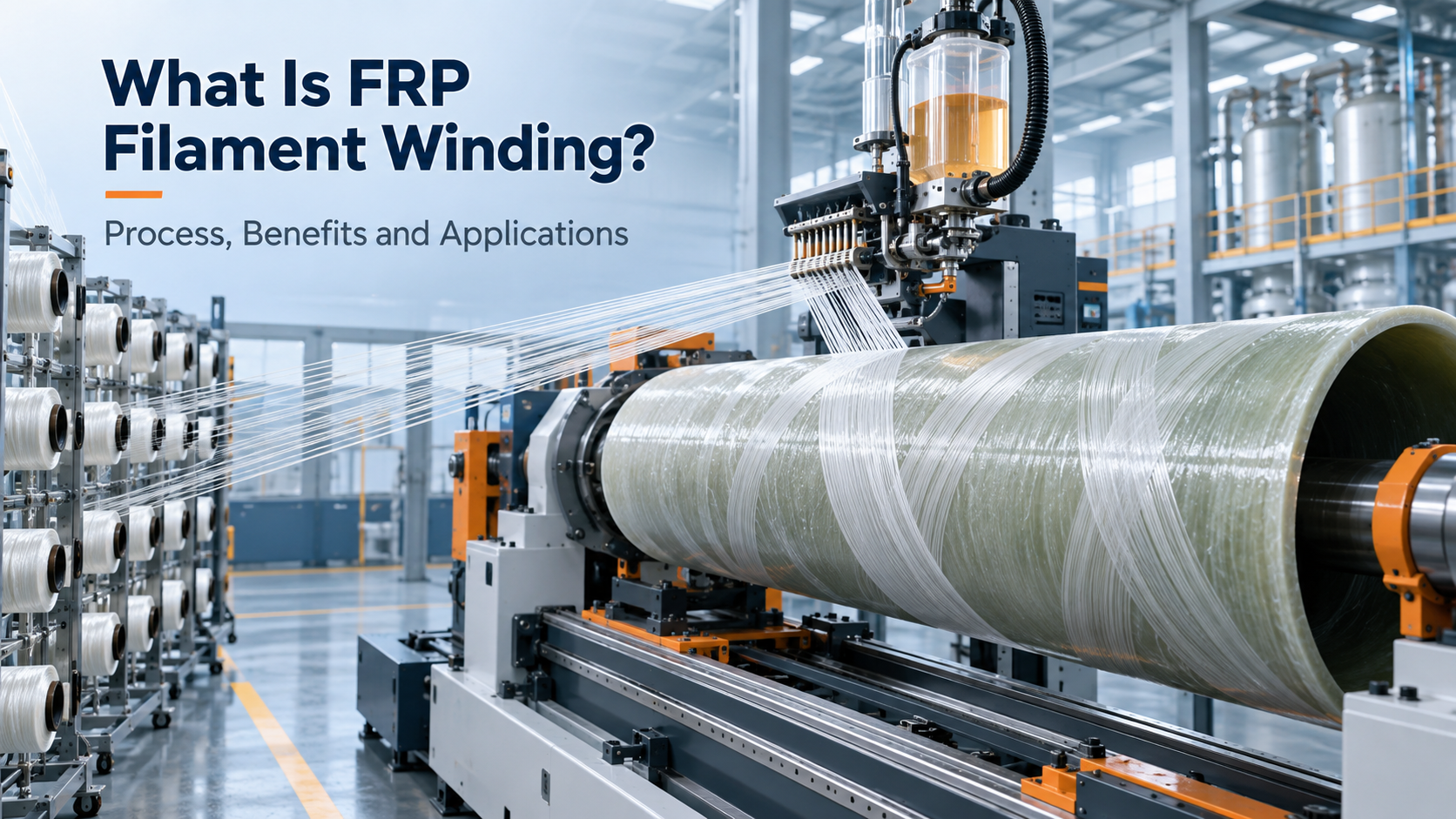
FRP filament winding is an automated composite manufacturing process used to produce strong, lightweight and corrosion-resistant hollow structures such as FRP pipes, storage tanks and pressure vessels.
During the filament winding process, continuous reinforcing fibers—commonly glass fiber—are placed around a rotating mandrel in a controlled pattern. The fibers are combined with resin to create a composite structure in which fiber direction can be adjusted according to the mechanical requirements of the final product.
Because the winding angle, fiber tension and material placement can be controlled, filament winding is especially suitable for cylindrical and rotationally symmetrical FRP products.
How Does the FRP Filament Winding Process Work?
Although equipment configurations vary, the basic filament winding process generally follows several stages.
1. Mandrel Preparation
The process begins with a mandrel that defines the internal shape of the finished product.
Depending on the product and manufacturing method, the mandrel may be reusable or may remain as part of the finished structure.
For pipes and cylindrical tanks, the mandrel rotates while fibers are applied to its surface.
2. Fiber and Resin Preparation
Continuous fiberglass rovings are fed from a creel.
In a typical wet winding process, the fibers pass through a resin system before reaching the mandrel. This allows the reinforcement to become impregnated with resin before being placed onto the product.
Different resin systems can be selected according to the intended chemical, temperature and mechanical requirements.
3. Controlled Filament Winding
The mandrel rotates while a carriage or fiber delivery system travels along its length.
By coordinating these movements, the machine places fiberglass at predetermined winding angles.
This is one of the most important characteristics of filament winding: the reinforcement does not have to be placed randomly.
Instead, fiber orientation can be designed to support the loads expected in service.
Common Filament Winding Patterns
Different winding patterns are used depending on the product.
Hoop Winding
Fibers are placed close to the circumferential direction of the product.
This configuration is useful when circumferential or hoop loads are important, such as in many pressurized cylindrical structures.
Helical Winding
Fibers travel at an angle along the length of the mandrel.
Helical layers help provide strength in both axial and circumferential directions.
Combined Winding
Many industrial FRP products use multiple layers with different fiber orientations.
Instead of relying on one winding angle, the laminate structure can combine corrosion barriers, structural layers and different winding patterns according to the design requirements.
What Materials Are Used in Filament Winding?
An FRP structure normally contains two main components:
Reinforcement
Glass fiber is widely used for industrial FRP pipes, tanks and chemical equipment. Other composite applications may use carbon or other reinforcing fibers.
Resin matrix
The resin holds the reinforcing fibers together and helps protect them from the operating environment.
The correct combination depends on factors including:
- chemical exposure
- operating temperature
- pressure
- mechanical loading
- required service conditions
For this reason, material selection should be based on the actual application rather than simply specifying “FRP.”
Why Is Filament Winding Used for FRP Products?
One of the main advantages of filament winding is controlled fiber placement.
Instead of using the same reinforcement structure in every direction, manufacturers can adjust fiber orientation according to the loads that the finished part is expected to carry.
Other advantages include:
- repeatable production
- controlled winding patterns
- suitability for long cylindrical products
- efficient use of continuous reinforcement
- automation of fiber placement
- ability to manufacture pipes, tanks and vessels in different sizes
Filament winding is particularly well suited to hollow and mainly axisymmetric composite structures.
Common Applications of FRP Filament Winding
FRP Pipes
Filament winding is widely used to manufacture fiberglass piping for industrial applications.
Depending on the pipe design, different laminate layers can be used to provide corrosion resistance, structural strength and stiffness.
FRP Storage Tanks
Horizontal and vertical FRP tanks can use filament-wound structural layers to create strong cylindrical shells.
These tanks are commonly considered for water treatment, chemical storage and industrial processing applications when the selected resin system is compatible with the stored medium.
Pressure Vessels
Filament winding is also widely used in composite pressure vessels because fiber orientation can be controlled around the pressure-bearing structure.
Other Cylindrical Composite Components
The process can also be adapted for ducts, tubes, vessels and other rotationally symmetrical composite products.
Filament Winding vs Other FRP Manufacturing Processes
Filament winding is not the only method used to manufacture FRP.
Hand lay-up, molding and pultrusion can all be appropriate for different geometries.
The main distinction is that filament winding is particularly suited to products where continuous fibers can be placed around a rotating form.
For example:
Filament winding: pipes, tanks and vessels
Pultrusion: continuous profiles and structural shapes
Hand lay-up: large or complex custom components
Molding: repeated components with defined mold geometry
The correct process depends on the product shape, production volume and performance requirements.
FAQ
What is filament winding in FRP?
Filament winding is a composite manufacturing process in which continuous reinforcing fibers are applied around a rotating mandrel in controlled patterns and combined with resin.
What products can be made by filament winding?
Common products include FRP pipes, storage tanks, tubes, pressure vessels and other cylindrical composite structures.
Why is winding angle important?
Fiber orientation influences how the composite structure responds to loads. Different winding angles can therefore be combined according to the required mechanical performance.
Conclusion
FRP filament winding combines continuous reinforcement, controlled fiber orientation and automated production to manufacture a wide range of industrial composite products.
For pipes, tanks and other cylindrical structures, the ability to control winding pattern and laminate construction makes the process particularly useful.
AOLIANDE provides FRP products and filament winding equipment for industrial applications. Contact our team to discuss your FRP product or production equipment requirements.
about
AOLIANDE FRP
AOLIANDE is a professional manufacturer of FRP products and filament winding equipment, providing customized solutions for industrial applications worldwide.